Wilderness
Book / Produced by partner of TOW
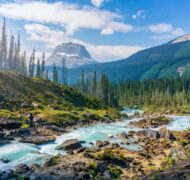
In the words of legislation that first granted it in 1964 some protection in the United States, wilderness is a place where “mankind is a visitor and does not remain.” In recent years places unmarked by human activity have come to seem increasingly valuable to human beings. Indeed, the popularity of wilderness-related activities—backpacking, river rafting, tours to Antarctica and the Amazon—has become so great that it sometimes threatens to destroy the very thing people have come to admire.
Ambivalence About Wilderness
Despite our recent enthusiasm for wilderness, we have always been ambivalent about it, as is evident in expressions like “urban wilderness” and “lost in the wilderness.” The word itself originally meant “a place of wild beasts,” wild here meaning “will-ed”—that is, creatures which follow their own, not a human, will. Early settlers of the New World saw the wilderness condition of the continent as a situation to be remedied by human industry, and for nearly three centuries “progress” was understood to be the advance of civilization over wilderness.
But as wilderness became more rare, its value gradually increased. Nineteenth-century naturalists like Henry David Thoreau (“In wildness is the preservation of the world”) and John Muir (founder of the Sierra Club) began to see spiritual values in wilderness. This idea that wilderness has spiritual value is widespread in our time. But just as important in arguments for protection have been the scientific arguments first advanced by American ecologist Aldo Leopold. Wilderness, he argued, is an example of “healthy land.” Human activity almost always simplifies the extraordinarily complex balance of living and nonliving things that are part of an undisturbed ecosystem (see Ecology). Quite apart from their spiritual values, argue ecologists, we need wilderness areas, large and small, as places where the wisdom of the natural world may be preserved and studied.
Many contemporary attitudes toward wilderness are deeply rooted in Scripture. The biblical words commonly translated “wilderness” are usually descriptive of the desert: barren, uninhabited land, of no value for agriculture. Usually such land is portrayed negatively. The Israelites’ forty years in the wilderness is, at least in part, a kind of punishment; a frequent threat of the prophets is that the land will become a wilderness. At the same time, wilderness came to be a place where, apart from the comfort and defenses of cities and farms, people came face to face with God: Moses, the children of Israel, David, many of the prophets, John the Baptist and Jesus all found the wilderness to be not only a place of hardship and trial but a place where they experienced God’s voice and grace.
It would be more helpful for Christians to think of wilderness as simply “creation”—God’s work, unshaped by human beings, good for its own sake, the result of the continuing love and sustaining care of the Creator. We are so used to seeing creation in terms of the uses we make of it that we seldom see it in its own intrinsic power and beauty. One of the most instructive biblical glimpses we have of wilderness is God’s answer to Job. The Creator answers his legitimate complaints by asking him to consider the vastness, intricacy and mystery of creation. In an increasingly human-centered civilization we also need to learn the lesson of our creatureliness, which wilderness can often teach us.
While it seems clear from the Bible (for example, in Romans 8:18-25) that creation waits to be brought into relationship with the human, it seems equally clear, from our dismal record of diminishing the richness of created life, that we have not yet learned to relate to creation in a way that does not silence its own voice. Till the day when we have so learned creaturely wisdom, there are good reasons to work for the preservation of, and the respectful experience of, those little bits of wilderness that remain, for they remind us, “The earth is the Lord’s and everything in it” (Psalm 24:1).
» See also: Backpacking
» See also: Ecology
» See also: Pollution
» See also: Traveling
» See also: Weather Watching
References and Resources
S. P. Bratton, Christianity, Wilderness and Wildlife: The Original Desert Solitaire (Scranton, Penn.: University of Scranton Press, 1993); R. Nash, Wilderness and the American Mind, 3d ed. (New Haven: Yale University Press, 1982).
—Loren Wilkinson

Popular Content
Popular Content
The Complete Book of Everyday Christianity: An A-Z Guide to Following Christ in Every Aspect of Life
The authors Robert Banks and R. Paul Stevens have partnered with The Theology of Work Project to offer The Complete Book of Everyday Christianity in its entirety here. All rights reserved.
This resource was originally published in 1997, and the text has not been updated.
Table of Contents
- The Complete Book of Everyday Christianity
- Introduction
- Abortion
- Abuse
- Accountability, Relational
- Accountability, Workplace
- Addiction
- Adolescence
- Adornment
- Advertising
- Affirming
- Aging
- Allowances
- Ambition
- Anniversaries
- Anxiety
- Architecture, Urban
- Art
- Authority, Church
- Automobile
- Backpacking
- Baptism
- Beauty
- Birth
- Birthdays
- Blessing
- Blessing, Family
- Body
- Boredom
- Breast-feeding
- Business Ethics
- Calling/Vocation
- Camping
- Career
- Chocolate
- Chores
- Christian Education
- Church
- Church as Family
- Church Buildings
- Church Conflict
- Church Discipline
- Church in the Home
- Church Renewal
- Church, Small
- Church Structures
- Circumcision
- Citizenship
- City
- Civil Disobedience
- Civility
- Clergy
- Climate Change (Written 2011)
- Clubs
- Coffee Drinking
- Cohabiting
- Comics
- Committees
- Communion
- Community
- Community, Rural
- Commuting
- Competency
- Competition
- Compromise
- Computers
- Computer Games
- Conception
- Conflict Resolution
- Conflict, Workplace
- Confronting
- Conscience
- Consumerism
- Contraception
- Contracts
- Conversation
- Counseling, Lay
- Craftsmanship
- Creation
- Credit
- Credit Card
- Crime
- Crowds
- Culture
- Dating
- Daydreaming
- Death
- Debt
- Denominations
- Depression
- Discipleship
- Discrimination, Workplace
- Divorce
- Dreaming
- Dress Code, Workplace
- Drivenness
- Drugs
- Eating
- Ecology
- Economic Crisis (Written 2011)
- Education
- Emotions
- Empty Nesting
- Entertainment
- Equipping
- Ethnocentrism
- Euthanasia
- Evangelism
- Examinations
- Failure
- Fairy Tales
- Faith Development
- Family
- Family Communication
- Family Goals
- Family History
- Family Problems
- Family Systems
- Family Values
- Farewell
- Farming
- Fellowship
- Femininity
- Fences
- Festivals - Christmas
- Festivals - Easter
- Festivals - Thanksgiving
- Financial Support
- Firing
- Forgiveness
- Freedom
- Friendship
- Games
- Gardening
- Gift-Giving
- Global Village
- Godparenting
- Gossip
- Grandparenting
- Greeting
- Grieving
- Guidance
- Habits
- Hate
- Healing
- Health
- Hobbies and Crafts
- Home
- Homemaking
- Homework
- Home Video
- Homosexuality
- Hospitality
- Humor
- Imagination
- Immigration
- Individual
- Information Superhighway
- Inner City
- Insurance
- Integrity
- Internet (Written 2011)
- Investment
- Justice
- Laity
- Laughter
- Law
- Law Enforcement
- Leadership
- Leadership, Church
- Leisure
- Letter Writing
- Life Stages
- Listening
- Lobbying
- Love
- Loyalty, Workplace
- Management
- Marriage
- Masculinity (Written 2011)
- Mass Media
- Masturbation
- Meal Preparation
- Megachurch
- Membership, Church
- Menopause
- Menstruation
- Ministry
- Miscarriage
- Mission
- Missions
- Mobility
- Money
- Movies
- Multiculturalism
- Music
- Music, Christian
- Nationalism
- Need
- Negotiating
- Neighborhood
- Networking
- New Reproductive Technology
- Newspapers
- Noise
- Nondenominationalism
- Office Politics
- Organization
- Organizational Culture and Change
- Organizational Values
- Ownership, Private
- Parachurch Organizations
- Parenting
- Part-Time Employment
- Partying
- Pastoral Care
- Pets
- Photography
- Planning
- Play
- Pleasure
- Political Parties, Joining (Written 2011)
- Politics
- Pollution
- Poverty
- Power
- Power, Workplace
- Prayer, Corporate
- Preaching
- Pregnancy
- Principalities and Powers
- Privacy
- Professions / Professionalism
- Profit
- Promising
- Promotion
- Public Spaces
- Public Transportation
- Quilting
- Racism
- Radio Listening
- Reading
- Reasoning
- Recreation
- Rest
- Restorative Justice (Written 2011)
- Retirement
- Rights
- Sabbath
- Sacraments
- Self-Esteem
- Service, Workplace
- Sexuality
- Shame (Written 2011)
- Shiftwork
- Shopping
- Shopping Malls
- Sickness
- Simpler Lifestyle
- Singleness
- Sleeping
- Small Groups
- Small Towns
- Social Action
- Social Media (Written 2011)
- Society
- Soul
- Speaking
- Spiritual Conflict
- Spiritual Disciplines
- Spiritual Formation
- Spiritual Gifts
- Spiritual Growth
- Sports
- States and Provinces
- Stewardship
- Storytelling
- Stress, Workplace
- Strikes
- Structures
- Suburbia
- Success
- Sugar, Sugary
- Sunday School
- System
- Talents
- Taxes
- Teaching
- Technology
- Telephone
- Televangelism
- Television
- Tentmaking
- Theater, Live
- Time
- Trades
- Traveling
- Unemployment
- Unions
- Vacations
- Values
- Virtual Reality
- Virtues
- Vision
- Visiting
- Vocational Guidance
- Volunteer Work
- Voting
- Waiting
- Walking
- Washing
- Watch
- Wealth
- Weather Watching
- Weddings
- Whistle-blowing
- Wilderness
- Will, Last
- Witness
- Work
- Work Ethic, Protestant
- Workplace
- Worldview
- Worship
- Zoning
Donate
Copyright
Image by Hendrik Cornelissen . Used with Permission.
Copyright 2024 by Robert Banks and R. Paul Stevens.
Previous editions published by NavPress InterVarsity Press (IVP) (1997), Graceworks (2011, 2018).
All rights reserved.
All Scripture quotations, unless otherwise indicated, are taken from the Holy Bible, New International Version. NIV Copyright 1984 by International Bible Society. Used by permission of Zondervan Publishing House. All rights reserved.